


Heavy Duty Gratings are designed to support heavy rolling and static loads on highways, plant floors, loading docks, inlet covers, and airport drainage facilities.
When specifying grating for your application, it is important to recognize the difference between “standard” gratings and “Heavy Duty gratings”.
Heavy Duty gratings are available in a wide range of products and finishes designed to provide a long-lasting, safe, and reliable installation.
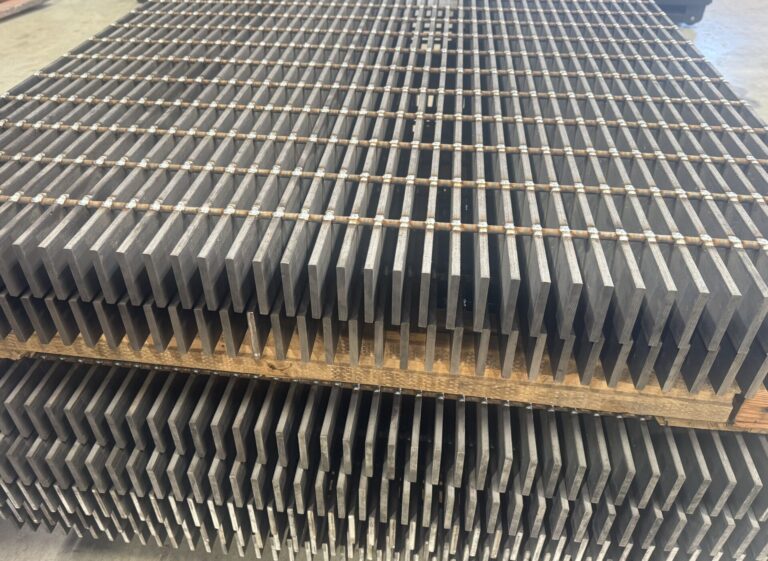
What is the difference between standard bar grating and Heavy Duty bar grating?
The simple difference between standard bar grating and Heavy Duty bar grating is the load that the grating is designed to support. Standard bar grating is designed to support pedestrian traffic and is typically manufactured with bearing bars 1/8” or 3/16” thick. Heavy duty bar grating is designed to support vehicular, forklift, and aircraft loads that travel over the grating. Heavy Duty grating is also popular for supporting machinery, and other types of large equipment loads that reside stationary on the grating. Heavy Duty bar gratings are typically manufactured with bearing bars ranging from ¼” to ½” thick and for specialty applications, bearing bars can exceed ½” thickness.
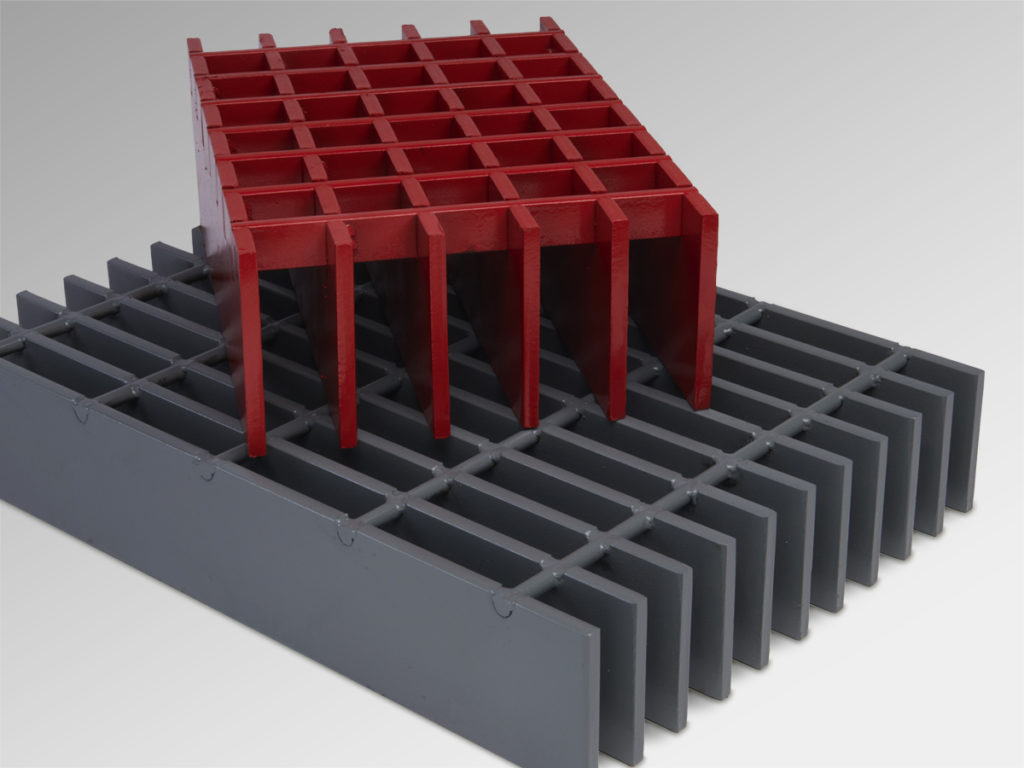
To support the anticipated loads, Heavy Duty bar gratings are commonly manufactured with bearing bars that are deeper than those specified for standard gratings. Additionally, Heavy Duty gratings are manufactured with larger cross bars to help support the anticipated loads.
How is Heavy Duty Bar Grating made?
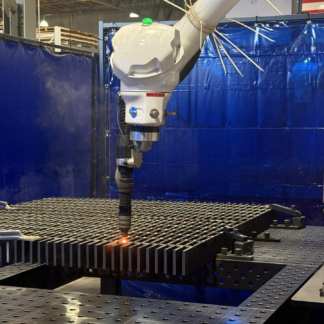
Heavy Duty bar grating is manufactured by one of two processes: electro forge welding on automated welding equipment, or “Shop Fabricated” where the grating is robotically or manually welded after preprocessing of the bearing bars. Either process routinely provides a stout, long-lasting product.
Electro forged welding is preferred when there is volume that justifies the complicated setup of the automated equipment, and the cross bar falls within parameters that allow for a proper welded connection of the bearing bar/cross bar intersection. Shop Fabricated Heavy Duty grating is preferred for short run production quantities. Additionally, shop fabricated products allow for the use of more robust cross bars that can be important for a life cycle of supporting highly concentrated wheel loads such as graders or aircraft, or for gratings subject to highly repetitive traffic patterns.
Proper specification of Heavy Duty bar grating requires knowledge of the anticipated load conditions and the application environment.
When specifying Heavy Duty bar grating, the load that the grating is required to support guides the selection of the depth and thickness of the bearing bars. The cross bars are then selected based upon the spacing of the bearing bars.
It is important to review the Heavy Duty Bar Grating Design Elements section of our website for technical details about Maximum Traffic Conditions, the Standard Spacings, and common Heavy Duty Grating Load Tables.
Grating Pacific’s technical sales and engineering teams are here to assist with the proper bar and spacing selections. These professionals are fully trained in both National Association of Architectural Metal Manufacturers Standards (NAAMM Standards) and American Association of State Highway and Transportation Officials (AASHTO) standards. These standards are commonly applicable to 1 ton, 3 ton, and 5 ton forklift loading, as well as automobile, H 15, H 20, H 25 truck, and aircraft loads.
Are there common spacings for Heavy Duty bar grating?
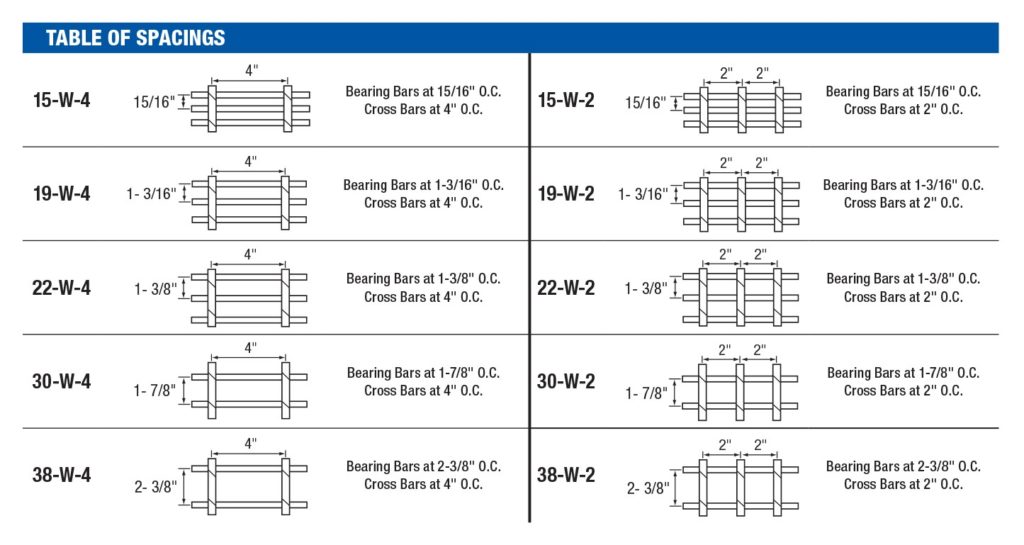
Grating Pacific provides the following, common spacings for Heavy Duty bar grating:
- 15 space, 15/16” on center spacing of bearing bars
- 19 space, or 1 3/16” on center spacing of bearing bars
- 22 space, or 1 3/8” on center spacing of bearing bars
- 30 space, or 1 7/8” on center spacing of bearing bars
- 38 space, or 2 3/8” on center spacing of bearing bars
When determining the bearing bar spacing, consideration should be given to the desired drainage and the need for air circulation. Wider spacings provide increased open area enhancing drainage and air circulation.
Cross bars are commonly spaced at 2” or 4” on center. The standard spacing for cross bars is 4” on center. Consider 2” on center cross bars for short spans or when additional surface area is desired.
Load table information is available for all common Heavy Duty bar grating spacings.
Are custom spacings of Heavy Duty bar grating available?
Yes, Grating Pacific can provide custom spaced Heavy Duty bar grating to suit the specific needs of nearly any application. Our technical sales and engineering teams are here to assist with custom gratings.
What spacing of heavy duty grating does a project require?
Proper specification of Heavy Duty bar grating requires knowledge of the anticipated load conditions and the application environment.
When specifying Heavy Duty bar grating, the load that the grating is required to support guides the selection of the depth and thickness of the bearing bars. The cross bars are then selected based upon the spacing of the bearing bars.
It is important to review the Heavy Duty Bar Grating Design Elements section of our website for technical details about Maximum Traffic Conditions, the Standard Spacings, and common Heavy Duty Grating Load Tables.
Grating Pacific’s technical sales and engineering teams are here to assist with the proper bar and spacing selections. These professionals are fully trained in both National Association of Architectural Metal Manufacturers Standards (NAAMM Standards) and American Association of State Highway and Transportation Officials (AASHTO) standards. These standards are commonly applicable to 1 ton, 3 ton, and 5 ton forklift loading, as well as automobile, H 15, H 20, H 25 truck, and aircraft loads.
Is Heavy Duty bar grating sold in standard panels or fabricated to size?
Due to the robust bars used to produce Heavy Duty gratings, most applications are fabricated to size in our manufacturing facilities. This includes cutting to finished size, end banding to close the open ends of the cut pieces, cut outs for penetrations, and hinges where necessary. Finishing is then applied as specified.
If the exact finished sizes are not available at time of ordering, and lead time is critical, standard panels can be produced for field fabrication. Panel sizes typically range from 2’0 to 3’ 0 wide, and 20’ 0 to 24’ 0 in span.
What other information do I need to consider when ordering Heavy Duty bar grating?
Load capacity is the single most important detail to know when selecting Heavy Duty bar grating.
Based on project application, material of manufacture needs to be selected. Grating Pacific offers Heavy Duty bar grating in ASTM A36 carbon steel or 300 series stainless steel.
Cross bar selection can significantly affect the service life of Heavy Duty gratings. Where repetitive repetitive vehicle or forklift traffic occurs, rectangular cross bars should be specified. Rectangular cross bars provide a deeper cross section and deflect much less under load when compared to round or twisted square cross bars. (See Cross Bar Selection Guide).
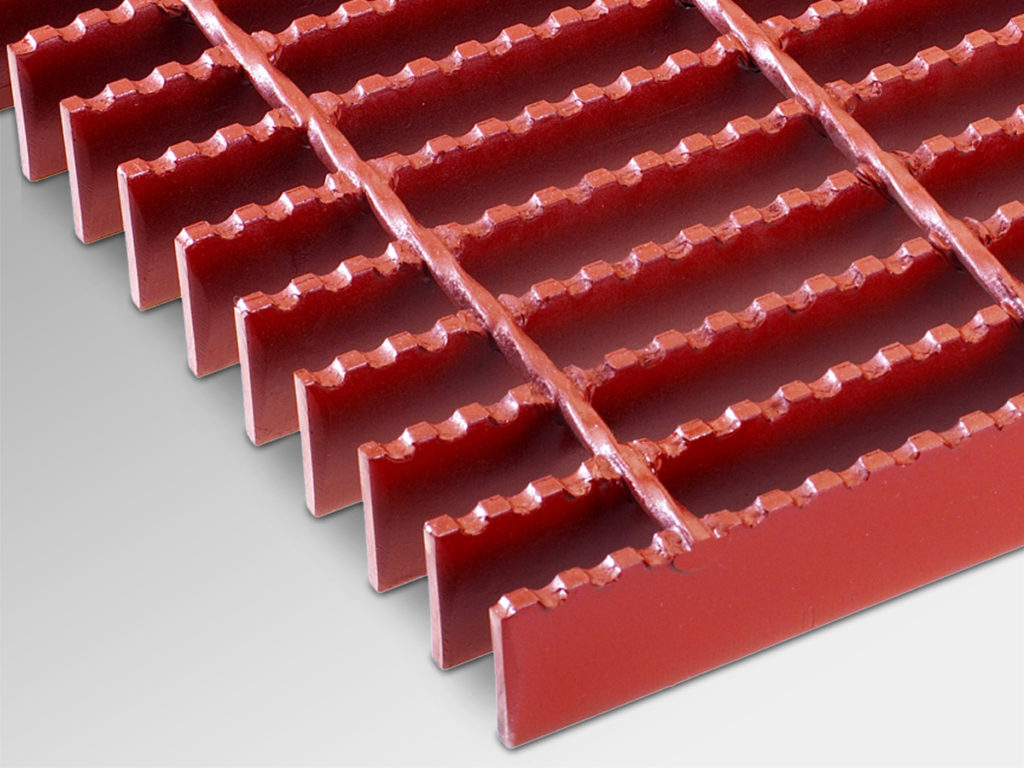
Slip resistance is another important factor to consider. All bar grating is provided in a standard smooth surface. For applications that require additional slip resistance, serrated bearing bars or “100% serrated” grating can be specified. If 100% serrated grating is requested then both the bearing bar and cross bar will be serrated. Other slip resistance surface options include Ongrip or Algrip applied grit surfaces.
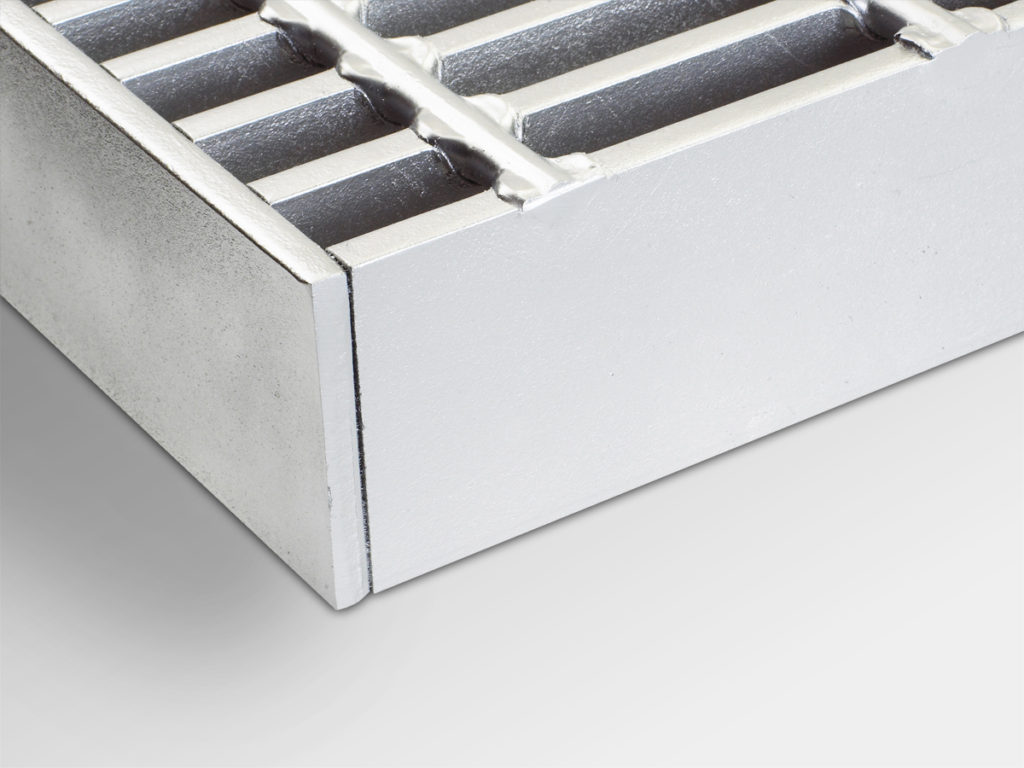
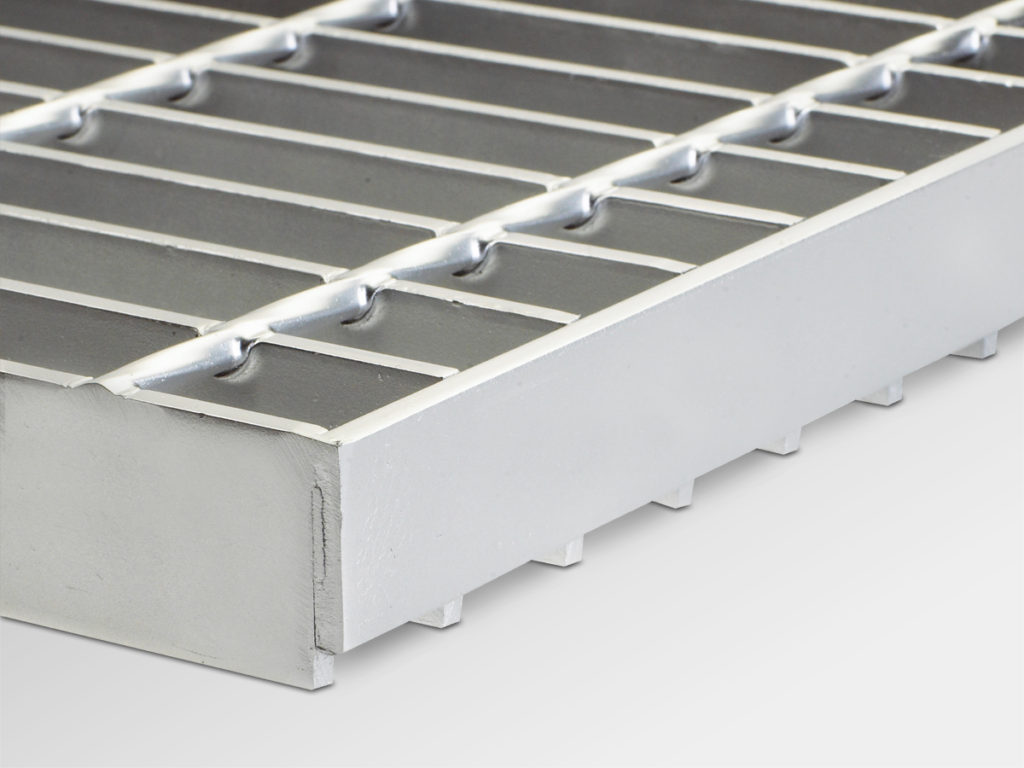
It is also recommended that most bar grating products, particularly Heavy Duty bar grating, are banded during the fabrication process. Banding is the process of welding a flat bar to the open ends of the grating. Banding provides additional rigidity to the grating panel and helps distribute vehicular loads throughout the grating panel. Trench banding can also be utilized, where the band bar is slightly shorter than the bearing bars. Trench banding is welded flush with the top of the grating and leaves an intentional gap at the bottom of the grating panel to facilitate maximum drainage.
Explore More Speciality Metal Fabrication Case Studies

Stella Apartments - Opus50
Fulfilling screening needs in stunning ways

UCI - Aluminum Bar Grating
Aluminum sunshades in a campus setting

The Boardwalk - Woven Wire
Appealing and functional infill panels
Full-Service Metal Grating: From Design Consultation to Logistics
Design & CAD Detailing
Precision from the start.
Custom Fabrication
Sawing, welding, and plasma cutting tailored to your specs.
Strategic Logistics
Fast delivery through our 5 service centers across the Western US.
